

Turn a Trump Account Into a Tax-Free Nest Egg

Want to build a solid tax-advantaged foundation for a child or grandchild? Here’s a strategy that uses a child’s Trump account and may be worth discussing with your tax and financial professionals.

THE CONCEPT

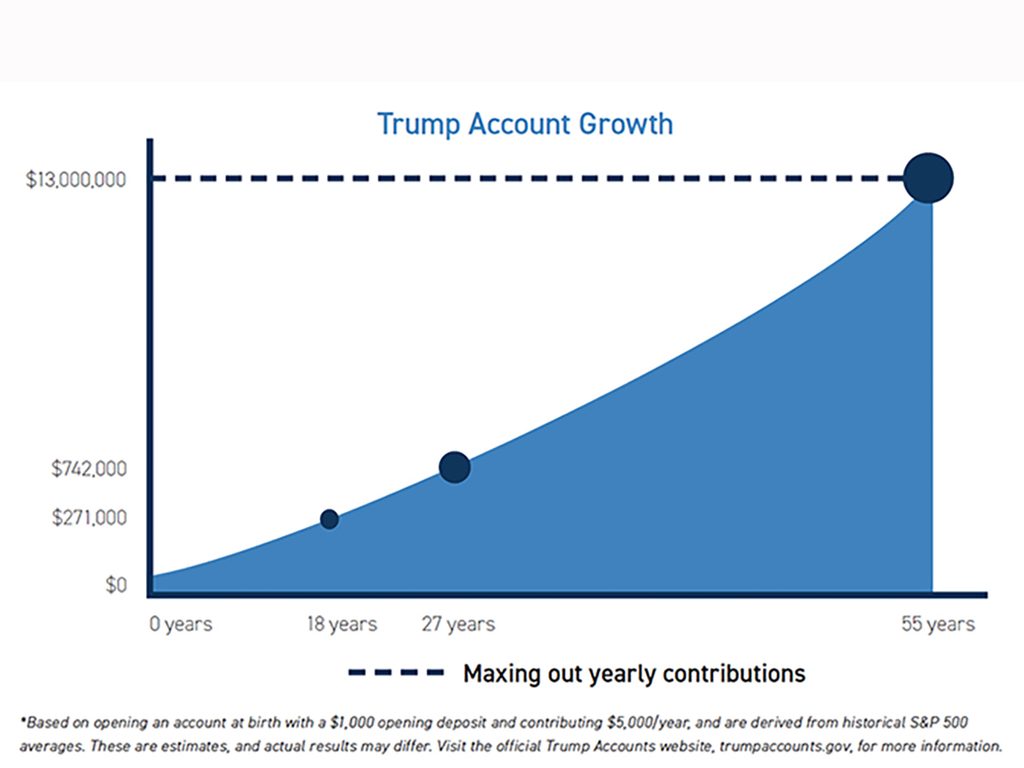
Your contributions to the child’s account aren’t tax-deductible. However, contributions you or others make grow tax-deferred, which can provide a substantial investment advantage. The strategy is designed to capitalize on tax-deferred growth to support your family’s long-term goals. Each year, maximize your contributions within the allowed limits. The limits for 2026 and 2027 are $5,000.

While the child owns the account, you manage it until they turn 18. After that, all contributions and earnings made before age 18 are treated as traditional IRA contributions and are subject to a 10% early-withdrawal penalty. These balances can also be rolled over into a Roth IRA.

THE TWIST

A series of well-planned Roth conversions is the twist. For many young adults, the year they turn 18 is an especially good time to begin converting the account to a Roth IRA. As long as the young adult’s total income—earnings plus the converted amount—is within the 0% tax bracket, no federal income tax will be owed. During the college years, similar partial conversions could also be untaxed. After that, the child could convert the remaining balance and pay the corresponding tax in the tax year the conversion is completed. Alternatively, they could continue partial rollovers until the entire balance has been converted, potentially paying less tax overall.

BENEFITS

Contributing early, during low-income years, secures decades of tax-free growth—a lasting tax advantage. Contributions to a Roth IRA, including those in a Trump account established in your child’s early years, may be withdrawn tax- and penalty-free before retirement. Your child can later use those funds to buy a home or start a business.
What are “Trump Accounts”?

Introduced in the One Big Beautiful Bill Act (OBBBA), these are governmentfunded investment accounts designed to help children build wealth from birth. Children born between January 1, 2025, and December 31, 2028, who are U.S. citizens and have a Social Security number, are eligible to receive a one-time $1,000 deposit from the U.S. Treasury to start the account. Children born outside these four calendar years are also eligible for an account, but they won’t receive the $1,000 in government seed money.

MAKING CONTRIBUTIONS

Parents, grandparents, and other individuals can make after-tax contributions of up to $5,000 per year to each account. Employers may also contribute up to $2,500 a year to accounts for their employees’ dependents. Any employer contributions also count toward the overall $5,000 cap. The contributions grow tax-deferred until withdrawn. Account investment options are limited to mutual funds* or exchange-traded funds that track a qualified index, such as the S&P 500.

EDUCATION PLANNING

Beginning the year the child turns 18, they can make penalty-free withdrawals for qualified educational costs. The child will incur regular income tax on earnings and tax-free contributions from the government and employers. Still, all after-tax contributions made by parents and others can be withdrawn tax-free. After age 18, the account functions similarly to a Traditional IRA, with continued tax-free growth and the ability to withdraw funds for any purpose starting at age 59-1/2.

Opening an account makes sense if your child is eligible for the $1,000 seed money. It may also be worth considering if your employer is willing to contribute to your child’s account. Accounts can be opened beginning July 4, 2026. More guidance from the Treasury is expected before then.

*Investors should carefully consider the investment objectives, risks, charges, and expenses of the fund before investing. Contact the issuing firm to obtain a prospectus, which should be read carefully before investing or sending money. Because mutual fund values fluctuate, redeemed shares may be worth more or less than their original value. Past performance won’t guarantee future results. An investment in mutual funds may result in the loss of principal.