

Building a Successful Partnership

A successful business partnership goes beyond shared enthusiasm—it requires careful planning, clear communication, and proactive decision-making. Partners must align on the company’s structure, financing, and conflict resolution to build a strong foundation.

START WITH SHARED VISION

Decide early how to finance the business and how to meet future capital needs. Whether through personal investment, bank loans, or outside investors, both partners should agree on the approach.

SECURE FUNDING TOGETHER

Discuss growth timelines, potential pivots, and how shifting priorities could impact roles and pay. Regularly reviewing these topics helps avoid misalignment as the business evolves.

CHOOSE THE RIGHT BUSINESS STRUCTURE

Evaluate options like LLC, S corporation, or C-corporation. Each provides different tax benefits, liability protection, and administrative requirements. Also, agree on how expenses will be shared and profits divided—usually based on ownership percentage or individual contributions.

PLAN FOR DISAGREEMENTS

Conflicts are inevitable. Create a decisionmaking framework in advance— whether designating one partner for final say, dividing authority by expertise, or requiring consensus on major financial decisions.

PROTECT THE BUSINESS

Obtain sufficient insurance coverage, including an umbrella policy for liability, property, and casualty risks. Consider errors and omissions insurance for professional services and key person life insurance to protect the company if a vital partner or employee passes away.

Control Versus Protection

When creating a trust, understanding the difference between revocable and irrevocable goes beyond just terminology. It can greatly influence asset protection and your control over those assets.

REVOCABLE TRUSTS

With a revocable trust, you retain control over the assets during your lifetime. You can modify or even cancel the trust as your situation changes. This flexibility can be helpful if you expect changes in your financial or family circumstances. However, because you retain control, the assets in a revocable trust usually aren’t protected from creditors or estate taxes. They are still considered part of your estate.

IRREVOCABLE TRUSTS

When you establish an irrevocable trust, you transfer control to someone else. Though it’s harder to change the trust later, it often provides significant advantages. Since you no longer own the assets, they can be protected from creditors and might be excluded from the taxable estate, potentially lowering your estate taxes.

When choosing between them, it’s important to consider your goals. If you need flexibility, a revocable trust might be best. If protecting assets and tax savings are priorities, an irrevocable trust may be a better choice. An experienced professional can help explain how each option aligns with your overall financial plan.

April 2026 Question and Answer

QUESTION

What is the pass-through income deduction for businesses?

ANSWER

This deduction was set to expire at the end of 2025, but it was extended by the One Big Beautiful Bill Act (OBBBA). Owners of some pass-through businesses can continue to claim a deduction of up to 20% of qualified business income, plus 20% of qualified real estate investment trust (REIT) dividends and qualified publicly traded partnership (PTP) income.

The deduction phases out at $403,500—$553,500 (joint filers), $201,750–$276,750 (single filers), and $201,775— $276,775 (married filing separately—not including the qualified business income deduction. Above these thresholds, the deduction is based on whether you’re a specified service trade business (SSTB).

Basics of Estate Planning

Estate planning is a crucial process that ensures your assets are managed and distributed according to your wishes after your death. The foundation of a solid estate plan involves several key components.

CREATE A WILL

It specifies how your assets—such as property, savings, and personal belongings—will be distributed. Without a will, state laws determine your estate’s distribution, which may not align with your wishes.

POWERS OF ATTORNEY

Consider establishing powers of attorney and healthcare directives. These legal documents designate trusted individuals to make financial and medical decisions on your behalf if you become incapacitated.

TRUSTS

Setting up a trust can be advantageous for controlling assets, avoiding probate, and minimizing taxes. Trusts can be especially helpful for managing assets for minors or beneficiaries with special needs. Regularly reviewing and updating your estate plan is essential, especially after major life events such as marriage, divorce, or the birth of a child.

Consulting with an estate planning attorney ensures your documents comply with current laws and accurately reflect your intentions.

Do You Have an Adequate Emergency Fund

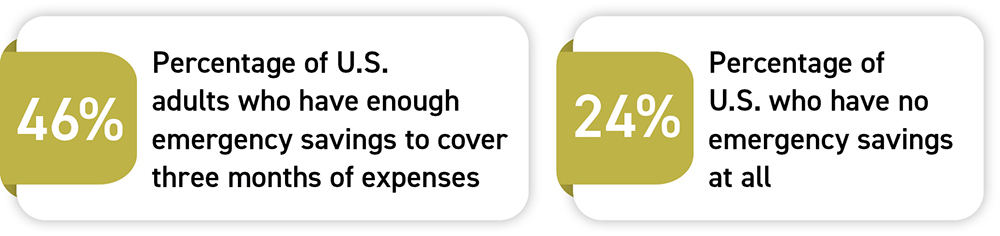
The 2025 Bankrate Emergency Savings Survey found that, despite lower inflation, it remains the main obstacle preventing Americans from saving for emergencies.

  • 46% Percentage of U.S. adults who have enough emergency savings to cover three months of expenses
  • 24% Percentage of U.S. adults who have no emergency savings at all

Source: Bankrate, 2025 Annual Emergency Savings Report

April 2026 Client Profile

Sarah, a florist in upstate New York, runs her boutique shop as a sole proprietorship. In 2025, her business nets $150,000 in qualified business income after expenses. Thanks to the Section 199A deduction— often called the pass-through deduction—she can deduct up to 20% of that income from her taxable amount, potentially saving her $9,000 in federal taxes, assuming she’s in the 22% bracket.

This deduction, made permanent under the One Big Beautiful Bill Act (OBBBA), benefits pass-through entities like LLCs, S corps, and partnerships, where income “passes through” to owners’ personal tax returns. In 2026, for Sarah, eligibility hinges on her business type and income level—under $201,750, with phase-outs above that. She must also ensure her income qualifies, excluding wages or investment returns.

By consulting a tax advisor, Sarah structures her finances to maximize deductions and reinvests savings into inventory. This scenario highlights how small businesses, like Sarah’s, can leverage such incentives to fuel growth, though rules may evolve—always verify with IRS guidelines and your tax professional for the latest updates.

Client Profile is based on a hypothetical situation. The solutions discussed may or may not be appropriate for you.

Building an Emergency Fund

With the holidays behind us, it’s a good time to review your savings and get back on track, especially if you had to dip into your emergency fund during the holidays. Having an emergency fund is key to ensuring funds are available when unexpected financial hardships occur. Aim to save 3-6 months’ worth of living expenses to give yourself peace of mind.

PUT IT IN WRITING

For many people, writing it down makes saving money for an emergency fund real, not theoretical. Talk with your loved ones to discuss how much you need and solicit ideas for finding the extra dollars that can add up over time. Make a chart and track how much you’re able to save each month toward your goal.

SHOW ME THE MONEY

Whether part-time gigging or selling unwanted items via the Internet or smartphone apps, you can potentially increase your disposable income — and your emergency funds — quickly. The same thing goes for raises and bonuses from work. Keep your car for an extra year or two to go without monthly car payments. Keep your phone, too, with new smartphone prices soaring.

MAKE SMALL SACRIFICES

Passing on one $5 designer latte, one $10 lunch, and one $75 dinner every two weeks is another way to quickly increase your funds.

MAKE BIGGER SACRIFICES

Still looking for free money to increase your emergency funds? Maybe you need to free it up by first creating a budget that includes your income and itemized expenses. Little adjustments add up. Scour your phone and cable bills to eliminate unneeded services. Study your clothes and grocery bills to find additional savings. Write down every dime you spend to get the best idea of where your money goes.

Review Your Succession Plan

Make sure to plan for what will happen to your business when you retire. Maybe your partner wants to buy you out, or you want to pass the business to your heirs. If you plan to sell your business to outside investors, you’ll need to get a valuation. Include any consultation fees if the new owner requires assistance during the transition.

Regardless of how you plan to transfer your business to new owners, consider how you’ll receive payment for your ownership. Will it be a single lump-sum payment, or will you receive monthly payments?

Your succession plan isn’t just for retirement. It’s also useful if you become ill, injured, or worse. And remember, your succession plan isn’t something you create and then forget. Situations change, so review your plan each year.

Estate Planning and Taxes

From an estate and gift tax perspective, the most significant change OBBBA made is a permanent increase to the estate, gift, and generation-skipping transfer (GST) tax exemption amounts. For 2026, these amounts are $15 million per individual or $30 million for a married couple, to be reviewed annually for inflation adjustments, up from $13.99 million per individual or $27.98 million for a married couple in 2025. The new legislation retains the TCJA-era tax brackets for trusts and estates. This means that for assets transferred during a lifetime or at death with a cumulative value exceeding the exemptions, the marginal tax rate remains 40% of the value over the exemptions.

SPOUSAL EXEMPTION PORTABILITY

If part or all of one spouse’s estate tax exemption is unused at that spouse’s death, the estate can elect to permit the surviving spouse to use the deceased spouse’s remaining exemption. This exemption portability provides flexibility upon the first spouse’s death. While a portability- only estate tax return can be filed up to two years from the deceased spouse’s death, it can be costly. Be aware that portability is available only from the most recently deceased spouse. It doesn’t apply to the GST tax exemption and isn’t recognized by many states for estate or inheritance tax purposes.

STATE-LEVEL ESTATE TAX

Even if your estate is no longer subject to federal estate tax, you need to review and coordinate with any estate and inheritance taxes your state may levy. States can impose separate estate taxes with exemption amounts that are significantly lower than the federal level. These lower thresholds mean state estate taxes could apply even when federal estate taxes don’t, making state-specific strategies essential for effective estate planning.

GIFT TAXES AND LIFETIME GIVING

The annual gift tax exemption is $19,000 per donor for each recipient in 2026. Amounts over that subtract from your estate tax basic exclusion amount.

If executed properly, paying for a grandchild’s or some other person’s tuition or medical expenses is an exception to the gift tax. Payments made directly to providers or schools aren’t considered gifts.

Consult your trusted advisor to explore these strategies and how they may work for your personal situation.

April 2026 Client Line Newsletter

Estate Planning and Taxes – the most significant change OBBBA made is a permanent increase to the estate, gift and generation-skipping transfer tax exemption amounts.

Review Your Succession Plan – make sure to plan for what will happen to your business when you retire.

Building an Emergency Fund – it’s a good time to review your savings and get back on track, especially if you had to dip into your emergency fund during the holidays.

April 2026 Client Profile

Do You Have an Adequate Emergency Fund? – despite lower inflation, it remains the main obstacle preventing Americans from saving for emergencies.

Basics of Estate Planning – estate planning is a crucial process that ensures your assets are managed and distributed according to your wishes after your death.

April 2026 Question and Answer

Control Versus Protection – when creating a trust, understanding the difference between revocable and irrevocable goes beyond just terminology.

Building a Successful Partnership – a successful business partnership goes beyond shared enthusiasm.